
Guide to Machalilla: Ecuador’s Under-the-Radar National Park
Found along Ecuador’s stunning Pacific coast, is a vibrant tapestry of landscapes, wildlife, and cultural heritage. Established in 1979, the park encompasses dry forests, tropical deciduous forests, beaches, rocky cliffs, and islands, making it one of Ecuador’s most diverse protected areas. One of the park’s most famous features is Isla de la Plata, often referred to as the “poor man’s Galápagos.”
Snorkeling and diving excursions around the island reveal vibrant coral reefs, sea turtles, and colorful tropical fish, making it a paradise for nature enthusiasts. On land, you can hike well-marked trails through dry forests and along cliffs that provide breathtaking views of the Pacific Ocean.
Machalilla National Park is also home to the archaeological site of Agua Blanca, a small village with remnants of the Manteño culture. While here, you can explore traditional mud-brick structures, learn about indigenous practices, and even enjoy the natural hot springs that the area is famous for. Here’s our comprehensive guide to Machalilla National Park;
Please Download Our Mobile App here.
Overview of Machalilla National Park
Located in Manabí Province, Machalilla is a strikingly diverse protected area that spans around 750 square kilometers. Established in 1979, the park encompasses a mosaic of ecosystems, including tropical dry forests, fog forests, scrub deserts, pristine beaches, and stretches of the Pacific Ocean. The scrub desert areas are populated with Opuntia cacti, algaroba trees, kapok trees, and palo santo trees.
There are also a handful of islands and coastal waterways. Among the park’s most notable features are the islands of Isla de la Plata and Isla Salango. The pair is often called the mini Galápagos for their remarkable resemblance to the famous archipelago. Isla de la Plata, in particular, is renowned for its colonies of blue-footed boobies, frigatebirds, and other seabirds.
On land, the Agua Blanca community offers a fascinating glimpse into Ecuador’s ancient Manteño civilization. Here, you can explore archaeological ruins and soak in a natural sulfur lagoon famed for its healing properties. It’s often the highlight for most of the park’s visitors.
Also Read: Best Resorts in Ecuador.
Wildlife in Machalilla National Park
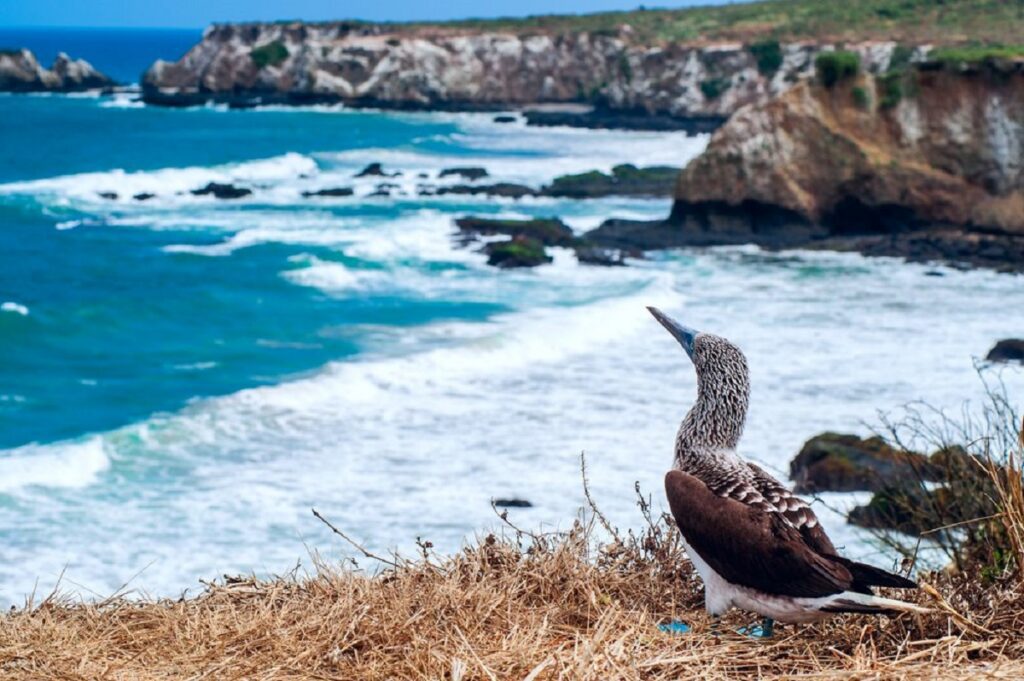
Machalilla National Park is a treasure trove for wildlife enthusiasts. Birdwatchers flock to the park to spot over 270 species of birds, many of which either migrate through or nest in the dry forest. Coveted sightings include the Peruvian screech owl, toucan, Golden-olive woodpecker, green macaw, and the elusive whooping motmot.
There are also mammals like armadillos, black howler monkeys, collared peccaries, and endangered white-tailed and gray brocket deer that roam among the trees. Reptiles are also never a miss, among these include; lizards, tortoises, and others. Marine life in Machalilla is equally spectacular. The park’s waters are a breeding ground for humpback whales that migrate along the coast between June and October.
Seabirds abound, including blue-footed, red-footed, and masked boobies, magnificent frigatebirds, and the rare waved albatross. The latter can only be found here outside of the Galapagos. Coral reefs and surrounding waters teem with sea turtles, dolphins, manta rays, tropical fish, and sea lions.
Best Time to Visit Machalilla National Park
The ideal time to visit Machalilla National Park is during the dry season, which runs from December to May. This period brings warm, breezy weather that makes exploring the park’s diverse landscapes, from its beaches to the islands, particularly enjoyable. Among these months, May stands out as a prime time to visit, offering warm temperatures ranging from 72 to 85 degrees Fahrenheit (22 to 30 degrees Celsius).
These conditions make it perfect not only for outdoor adventures like hiking and island excursions but also for experiencing the local culture and food. If you’re looking for something unique, plan your trip between June and October. During this window, humpback whales migrate to waters near the park, offering the unique experience of seeing them breed.
From January to May, there are several snorkeling tours that lead to coral reefs and surrounding islands teeming with marine life. So, if you are strictly here for water activities, this should be your window. Most of them handle the general logistics like transport and meals, ensuring you have a seamless experience.
Getting to Machalilla National Park

Reaching Machalilla from Quito can be approached in several ways depending on your budget, time, and travel preferences. The most common entry point is the nearby town of Puerto López, which is accessible by direct bus from Quito’s Terminal Terrestre Quitumbe. This option is often the most budget-friendly, offering a straightforward route that takes roughly 10 to 11 hours.
Alternatively, you can take a bus to a larger coastal city such as Manta or Montecristi and then transfer to another bus heading to Puerto López. This route can provide more flexible schedules and may shorten overall travel time, though it involves coordinating two separate bus trips. For those who prefer greater independence and the ability to explore along the way, driving from Quito is a feasible option.
The journey covers around 427 kilometers and typically takes around seven hours. Flying is another possibility, though it is obviously the most expensive option. Flights from Quito to either Manta’s Eloy Alfaro International Airport or Guayaquil’s José Joaquín De Olmedo International Airport are available everyday. From there, you’ll continue by bus or taxi to reach Machalilla National Park.
Other Activities in Machalilla National Park
One of the main draws is Los Frailes, widely regarded as one of Ecuador’s most pristine beaches. With its soft, powdery sand and crystal-clear waters framed by rolling hills, the beach offers a serene setting for relaxation and swimming. Part of the beach is protected to safeguard breeding and nesting sea turtles.
Isla de la Plata provides another exciting adventure, often called the accessible alternative to the Galápagos Islands. Here, you can observe blue-footed, red-footed, and Nazca boobies in their natural habitat. There are several snorkeling and scuba diving tours that reveal a vibrant underwater world inhabited by giant sea turtles, whales, and manta rays.
For those interested in history and culture, a visit to Agua Blanca offers a fascinating look into the region’s past. The local community maintains an archaeological museum and site, where ruins tell the story of six different cultures that once inhabited the area. Beyond these highlights, hiking is a popular way to explore the park, whether along the beaches, on the islands, or through nearby trails.
Park Fees in Machalilla National Park

Machalilla charges no admission fee. However, certain attractions within the park charge a separate fee for access. For instance, the Agua Blanca community charges around $5. This comes with a community-assigned guide and allows access to the museum.
FAQs
Is Machalilla National Park worth visiting?
Yes, Machalilla is definitely worth visiting because it offers a unique combination of natural beauty and cultural experiences. Travelers can enjoy the pristine sands and clear waters of Playa de los Frailes. You can also immerse in the traditions and history at the village of Agua Blanca.
How long to spend in Machalilla National Park?
To fully appreciate Machalilla, you should plan to spend at least one full day, though a 2-3-day visit is ideal. This allows time to enjoy key experiences like a day trip to Isla de la Plata and biking excursions to the scenic Los Frailes beach. While it is possible to visit the park for a single day if you focus on one activity, staying multiple days gives you the chance to cover more ground at a relaxed pace.
Conclusion
Machalilla is one of Ecuador’s most captivating destinations. From the dry forests to the vibrant Isla de la Plata and the charming local communities, the park presents experiences for every type of traveler. Its blend of adventure, relaxation, and cultural discovery ensures that every visit leaves a lasting impression.